

Table of Contents
- Oversized vs. Baggy: What the Label Actually Means
- The 3-Point Fit Check: Shoulders, Sleeves, and Hemline
- How to Verify Oversized Fit with Measurements
- Size Down or True-to-Size? A Decision Framework
- How Fabric Affects Oversized Streetwear Fit
- Heavyweight Cotton Hoodies for Winter: What to Look For
- How to Style Oversized Hoodies Without Looking Sloppy
- Frequently Asked Questions
Last Updated: September 16, 2026
Oversized vs. Baggy: What the Label Actually Means
Oversized and baggy are not the same thing, and knowing how to tell if streetwear fits oversized starts with that distinction. Oversized is a deliberate design choice: cut wider and longer than standard sizing, but every proportion still follows a plan. Baggy describes fabric that hangs without structure, usually because the piece is simply too big rather than intentionally cut.
Intentional Design vs. Ill-Fitting Garments
An intentionally oversized garment has a wide body and dropped shoulders that still align with the rest of the cut. An ill-fitting one has excess fabric in the wrong places: shoulders that slide off, sleeves that swallow your hands, a hemline that sags unevenly.
The 3-Point Fit Check: Shoulders, Sleeves, and Hemline
The fastest way to judge oversized fit is a three-point check: shoulder seam position, sleeve length, and hemline placement. Run all three before deciding anything.
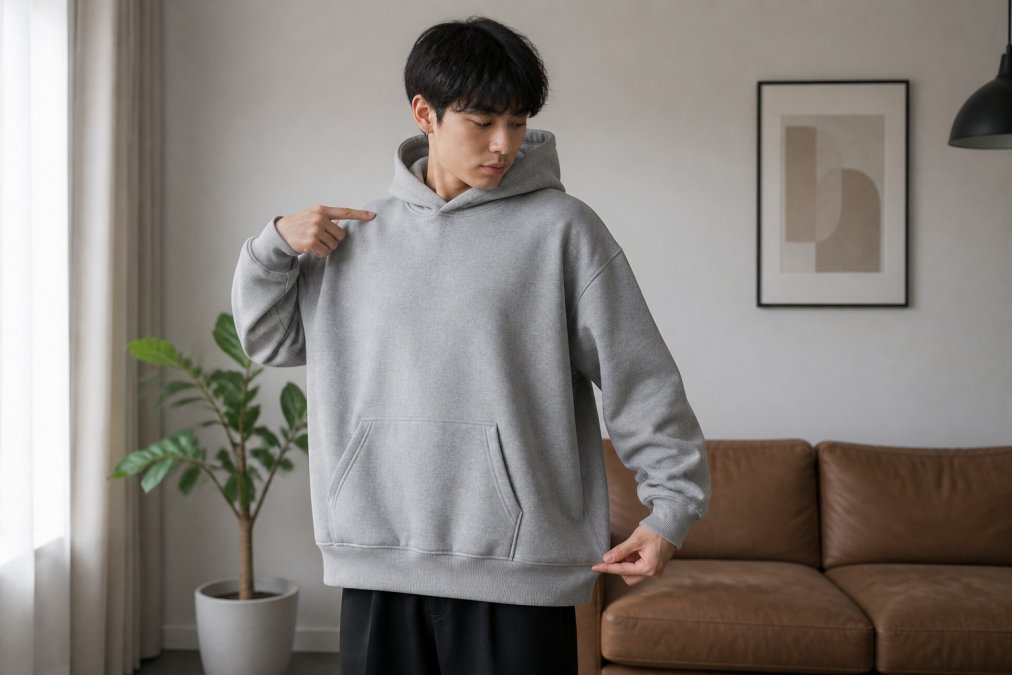
Shoulder Seam Placement
On a true oversized cut, the shoulder seam sits past the edge of your natural shoulder, often by several centimeters. That's the drop-shoulder construction you see on pieces like the "Purpose" Oversize Heavyweight Fleece Hoodie and most premium streetwear.

Sleeve Length and Body Width
Sleeve length on an oversized piece typically ends at or just past the wrist bone, not at the fingertips. Body width should give you room to layer without the fabric bunching under the arms.
How to Verify Oversized Fit with Measurements
Measurement-based verification is the most reliable method, and it's the step most fit guides skip. Pull the garment's size chart and compare three numbers against a piece you already own and like.
| Measurement | Where to Measure | What Oversized Looks Like |
|---|---|---|
| Shoulder | Seam to seam across the back, laid flat | 1.5-3 inches wider than your natural shoulder line |
| Chest | Armpit to armpit, doubled | 4-6 inches of extra room vs. a standard fit |
| Length | High point of shoulder to hem | Hits at or below the hip bone |
| Sleeve | Shoulder seam to cuff, measured along the outer arm | Ends at or just past the wrist bone |
How to Take the Measurements Yourself
Lay the garment flat on a hard surface, not a bed or couch, so the fabric doesn't stretch or sag. Smooth out wrinkles but don't pull. Use a flexible tailor's tape kept parallel to the seams, a tape that angles across the chest will read wider than the garment actually is.
- Shoulder: Find the seam where the sleeve meets the body on each side. Measure straight across the back from seam to seam.
- Chest: Measure from one armpit seam to the other, then double the number. This is the standard convention most size charts use.
- Length: Start at the highest point of the shoulder (where the collar meets the shoulder seam) and measure straight down to the bottom of the hem.
- Sleeve: Measure from the shoulder seam down the outside of the sleeve to the cuff edge.
How Body Type Changes the Target Numbers
Most fit guides give one set of rules for everyone, which is why so many shoppers end up with a piece that's oversized in the wrong places. The same 4-inch chest increase reads very differently depending on your frame.
- Petite frames (under about 5'4"): A 4-inch chest increase can swallow the torso and push the hem past the hip, shortening the leg line. Look for a shorter body length (around 26-27 inches for a hoodie) and a 1.5-2 inch shoulder drop rather than 3.
- Tall frames (over about 6'0"): A standard oversized cut may only read as relaxed because the extra width is spread over more height. You often need a longer body length (29-31 inches) and a wider chest (6-8 inches over standard) for the same visual effect.
- Broad shoulders: A 3-inch drop-shoulder seam can slide down the arm and look like a mis-size. Aim for a 1.5-2 inch drop and let chest width carry the oversized look.
- Narrow shoulders: You can carry a deeper shoulder drop (2.5-3 inches) without the garment looking like it's falling off, because the chest-to-shoulder ratio stays balanced.
Reading Size Charts That Use Different Conventions
Not every brand measures the same way, and this is where most online returns happen. Some charts list half-chest (armpit to armpit, single) and some list full chest (doubled). A chart showing "22 inches chest" on a size medium is almost certainly half-chest, meaning a 44-inch full chest. Assume full chest and you'll order far too small.
Other conventions to watch:
- Body length is sometimes measured from the high point of shoulder and sometimes from the back of the neck. The difference is usually 1-2 inches.
- Sleeve length is sometimes measured from center back (across the shoulders and down the arm) rather than from the shoulder seam. Center-back sleeve measurements run 4-6 inches longer than shoulder-seam measurements on the same garment.
- Shoulder width is occasionally listed as "across shoulder" (seam to seam) and occasionally as "shoulder to shoulder" including the sleeve cap. These are not the same number.
Size Down or True-to-Size? A Decision Framework
Size down if you want a relaxed fit that still shows your shape. Stay true-to-size if you want the full oversized silhouette the designer intended.
Use this framework:
- Size down when the chart shows an oversized cut and you're between sizes, or when you plan to wear the piece as a mid-layer.
- Stay true-to-size when the garment is labeled oversized and you want the drop-shoulder look as photographed.
- Never size up on an already-oversized piece unless you specifically want a baggy result.
How Fabric Affects Oversized Streetwear Fit
Fabric weight and fiber content change how an oversized piece behaves on your body, and whether the silhouette survives the first wash. Heavyweight cotton holds its shape and creates clean lines; lighter blends collapse and read as baggy instead of structured.
The Mechanisms Behind the Look
Three fabric properties drive whether an oversized cut reads as designed or accidental:
- Yarn structure. Ring-spun cotton, where fibers are twisted tightly into a fine, strong yarn, produces a smoother, denser surface that holds a boxy shape. Open-end (carded) cotton is loftier and weaker, so it pills faster and loses structure at the shoulders and hem.
- Fabric weight. Weight is measured in ounces per square yard (oz/yd²) in the U.S., or grams per square meter (GSM) internationally. The conversion is roughly 1 oz/yd² = 33.9 GSM. A 10 oz/yd² hoodie is about 339 GSM; a 14 oz/yd² hoodie is about 475 GSM. Anything under about 8 oz/yd² (270 GSM) tends to drape close to the body and won't hold a drop-shoulder line.
- Knit density and stretch. A tight, low-stretch knit keeps its shape. Adding elastane (spandex) improves comfort but lets the fabric relax over time, so a 5% elastane blend can lose 1-2 inches of chest width after a few wears compared to 100% cotton of the same weight.
How Fiber Content Changes the Silhouette
- 100% cotton, 10-14 oz/yd²: The benchmark for structured oversized streetwear. Holds the shoulder drop, keeps the hem from curling, and softens with wear without collapsing. Expect 3-5% shrinkage on the first wash if not pre-shrunk.
- Cotton-poly blends (roughly 50/50 to 80/20): More durable and less prone to shrinking, but polyester reduces the fabric's ability to hold a crisp edge. A 50/50 blend at 10 oz/yd² drapes closer to the body than 100% cotton at the same weight.
- Cotton with elastane (2-5%): Comfortable and forgiving, but the stretch lets the garment relax into your body shape. For the full oversized silhouette, keep elastane under 3% or size up slightly to compensate.
- French terry vs. fleece: French terry (loops inside) is lighter and drapes more; brushed fleece (raised inside) is warmer and holds a boxier shape. For an oversized hoodie you want to keep its cut, brushed fleece at 10 oz/yd² or higher is safer.
What Happens After Washing
Shrinkage and pilling are the two ways an oversized piece stops being oversized. Cotton knits commonly shrink 3-5% in length and 2-4% in width on the first hot wash. On a 28-inch body length, that's roughly 1-1.5 inches, enough to move a hem from below the hip to at the waist. Wash cold and tumble dry low to keep shrinkage near the low end.
Matching Fabric to the Season
Fabric weight should track the season, not just the aesthetic. A 14 oz/yd² hoodie in July will drape stiffly and feel heavy; a 7 oz/yd² hoodie in January won't hold its shape under a jacket. For year-round oversized streetwear, 10-12 oz/yd² cotton or cotton-forward blends hit the sweet spot between structure and comfort.
Heavyweight Cotton Hoodies for Winter: What to Look For
For winter, fabric weight is the deciding factor. Look for heavyweight cotton hoodies in the 10-14 oz/yd² range, which hold structure, block wind better, and layer cleanly under a jacket without adding bulk.
Check these specs before buying:
- Fabric weight: 10 oz/yd² or higher for real warmth
- Fiber content: higher cotton percentage for structure, some polyester for durability
- Construction: drop shoulder, reinforced seams, and a hem that holds its shape
- Care: machine washable and tumble dry low keeps the fit consistent
How to Style Oversized Hoodies Without Looking Sloppy
Balance visual volume with fitted pieces below the waist. An oversized top paired with wide-leg bottoms doubles the bulk and reads as sloppy rather than styled.
Three rules that work:
- Anchor the silhouette. Slim or straight-leg bottoms contrast the wide top.
- Keep one element oversized. If the hoodie is oversized, the pants and shoes should be closer to true fit.
- Use layering deliberately. A fitted base layer under an oversized hoodie adds depth without extra width.
Frequently Asked Questions
What is the difference between oversized and just a larger size?
Oversized clothing is cut with extra room in the shoulders, chest, and body from the start, while sizing up on a regular fit just scales up the same proportions. An oversized streetwear fit has a dropped shoulder seam, wider body width, and a longer hemline by design. If you size up in a regular tee, the sleeves get longer and the neckline stretches, but you lose the intentional silhouette. Always check the garment label and size chart to confirm the cut.
How should an oversized hoodie fit in the shoulders?
The shoulder seam should sit 1 to 2 inches below your natural shoulder line for a true oversized look. If the seam hangs more than 3 inches past your shoulder, the hoodie is likely too big and will look sloppy rather than intentional. For heavyweight cotton hoodies for winter, a slightly wider shoulder drop helps with layering, but the seam should still align with the upper arm, not the elbow. Use a fit check photo to compare.
Does oversized clothing mean I should size up?
Not always. Many streetwear brands design oversized pieces to fit true-to-size, meaning you order your normal size and get the intended relaxed fit. Sizing up in an already oversized garment often leads to excessive fabric volume that disrupts proportions. Check the brand's fit guide and customer reviews for guidance. If the brand labels the item as oversized, start with your true size and only size down if you want a less exaggerated silhouette.
How do I know if my streetwear is too big or intentionally oversized?
Look at the garment construction: intentional oversized pieces have a boxy cut, dropped shoulders, and a hemline that hits at mid-hip or lower. If the sleeves swallow your hands completely or the body width exceeds your chest by more than 6 inches, it may be too big. Also consider fabric drape. Heavyweight cotton holds structure, so an oversized fit looks deliberate. Thin, clingy fabrics in the same dimensions tend to look like a poor fit rather than a style choice.
Getting oversized streetwear right comes down to three things: reading the construction, verifying with measurements, and matching fabric to the season. Most shoppers skip all three and end up with a garment that's simply too big. Attitudz Apparel builds faith-inspired oversized hoodies and heavyweight fleece with drop-shoulder cuts, cotton-forward fabrics, and size charts detailed enough to verify the fit before you order. Shop now and find a piece that holds its shape and carries your values.